
Prologue
The steel box changed the world, and
almost nobody noticed. Before the
shipping container, the movement of
goods was chaos, a waterfront of ten
thousand decisions made by ten
thousand hands, bales and barrels
and crates hauled one by one up the
gangplank, stowed by stevedores who
worked by feel and experience,
off-loaded the same way on the other
side of the ocean. A ship might spend
more time in port than at sea. A
longshoreman's back was the engine of
global trade.
Then someone figured out that if you
standardized the box, made it a
fixed size, stackable, transferable
from ship to truck to rail without
ever breaking the seal, you could
move the world faster, cheaper, and
with fewer hands than anyone had
dreamed possible. The industry
called it containerization. The men
who understood what it would mean,
who got there first, who held the
right patents at the right moment,
those men would own a piece of every
transaction on every ocean for the
next century.
Robert Towers understood it in 1951,
working by lamplight at a drafting
table in a house in Pico, California,
because he was an engineer and
engineers see problems before the
rest of the world knows there's a
problem to see. He was a man who had
done his apprenticeship in the Army
Corps, who had spent twenty years at
the Port of Los Angeles doing good
work that received modest credit,
who believed that a clean design
was its own kind of justice.
He believed that the right answer
prevails.
He was right about the container.
He was wrong about the rest.
The men who came for his work were
patient, well-funded, and thorough.
They filed papers in federal
offices and paid lawyers to file
more papers. They waited. They
assumed that time and money were
on their side, and they were
correct, right up until the
morning a letter arrived on a desk
above a bakery on Whittier
Boulevard, and two private
investigators from East Los
Angeles decided to find out who
had been stealing from a dead man.
This is the story of what they
found.
PLEASE CRITIQUE THIS CHAPTER AT:
solartoys@yahoo.com
IF YOU WANT TO READ THE NEXT
CHAPTER EMAIL ME:
solartoys@yahoo.com
| |||||||
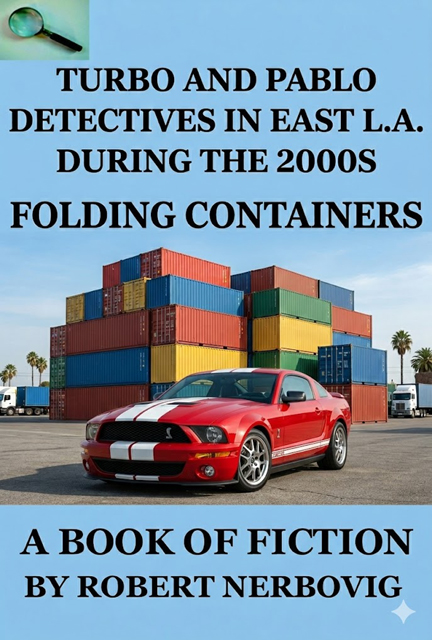
|
The smell of Mexican sweet bread, the sugary, yeasty scent of conchas and empanadas, always managed to find its way through the floorboards of the second-story office on Whittier Boulevard. It was a scent that didn't belong in a detective's office, but then again, Turbo and Pablo didn't much belong in the world of private investigation, either. They were investigators with years of Experience with the cold, hard reality of East Los Angeles street-level problems. Turbo sat behind a desk that had seen better decades, his eyes fixed on a yellowed roll of drafting paper that was weighted down by a small Appleton spotlight, the one Turbo had on his '49 Chevy. The paper was covered in his father's handwriting, precise, architectural lines that detailed the "Lattice-Fold" shipping container. It was a design that shouldn't have worked: a forty-foot steel box that could collapse into a four-foot slab of reinforced alloy using nothing but the weight of its own corners. "He was twenty years ahead of his time, Pablo," Turbo said, his voice like gravel grinding in a mixer. He traced a finger along the hinge-point of the main support strut. "The shipping companies didn't want it back in '62. They wanted volume, not efficiency. They wanted to clog the ports with empty iron because empty iron meant they could charge for the storage space. My old man saw the 'Empty Mile' coming before the first container ship even left Long Beach." Pablo was standing by the window, his silhouette framed by the flickering neon sign of the panaderia downstairs. He was cleaning a pair of night-vision goggles with a silk cloth, his movements slow and deliberate. "The problem isn't the design, Turbo. The problem is that someone just realized the patent expired last Tuesday. I saw two black Sedans idling near the 6th Street Bridge this morning. They weren't there for the tacos. They were looking at this building like it was a target on a shooting range." Turbo looked up, his jaw set. His experience hadn't taught them how to run, and it certainly hadn't taught them how to give up a family legacy to suits in black cars. "The prototypes are still at the old yard near the L.A. River. If those containers are as valuable as the old man thought, they aren't just looking for the blueprints. They're looking for the 'Master Key', the hydraulic sequence that triggers the fold." "You still have the brass tube?" Pablo asked, turning away from the window. Turbo reached into the bottom drawer of the desk and pulled out a heavy, salt-crusted PVC tube with brass end-caps. Inside that tube was the only functioning manual trigger for the Lattice-Fold logic. It was a mechanical key for a mechanical problem. "I've got the key," Turbo said, standing up and grabbing a grease-stained field jacket. "But we're going to need more than a tube if GML is involved. Those guys don't negotiate with detectives from East L.A. They just 'compress' the competition." "Then let's get to the yard before the sun goes down," Pablo said, checking the action on his sidearm. "I'd hate to see your father's life work turned into a tax write-off for a bunch of guys who don't know the difference between a hinge and a heartbeat." They headed down the narrow, creaking staircase, the scent of the bakery following them out into the humid L.A. afternoon. The street was alive with the sound of low-riders and the rhythmic thumping of Norteno music, but as Turbo stepped onto the sidewalk of Whittier Blvd, he felt the familiar prickle at the back of his neck. The black Sedans were gone, but the air felt heavy. "We take the Ford," Turbo commanded. "And Pablo? Keep the goggles ready. I have a feeling the 'Empty Mile' is about to get very crowded." The Ford Econoline didn't just idle; it cleared its throat with a rhythmic, mechanical cough that vibrated through the bench seat and into Turbo's lower back. The van was a relic, a 1978 workhorse that smelled of stale coffee, WD-40, and the faint, metallic tang of brass cleaning solution. As Turbo shifted the column-mounted gear lever into Drive, the transmission clunked, a heavy, satisfying sound of iron meeting iron. "The 6th Street Bridge is choked with traffic, Turbo," Pablo noted, his eyes scanning the side mirrors with the practiced twitch of a man who had spent too many nights during stakeouts. "If those black sedans are GML scouts, they aren't going to take the surface streets. They'll be coming down the 101, trying to cut us off before we hit the industrial spur at the river." Turbo gripped the thin, plastic steering wheel, his knuckles white against the grime. "Let them come. They know the patent, but they don't know the yard. My father didn't just store those containers; he 'folded' the layout of the entire lot. If you don't have the sequence, that yard is just a pile of scrap metal that'll crush a man in ten seconds flat." They turned off Whittier Boulevard, leaving behind the colorful murals and the scent of the panaderia. The transition into the industrial heart of East L.A. was abrupt, a landscape of rusted chain-link fences, scorched asphalt, and the jagged skeletons of warehouses that had been abandoned since the mid-eighties. This was the "Empty Mile" in its purest form, a graveyard of logistics where the dreams of the 1960s had come to die under the weight of modern efficiency. "There's the gate," Pablo whispered, leaning forward. The entrance to the Towers Shipping Yard was a pair of twenty-foot iron gates, held shut by a chain thick enough to anchor a destroyer. Turbo killed the engine, letting the Ford coast to a silent halt in the shadow of a decaying overpass. He reached into the glove box and pulled out a heavy brass key, not a digital fob, but a four-pound piece of forged steel that felt like a weapon in his hand. "Wait," Pablo said, his hand moving to the holster at his hip. "The dust on the asphalt. Look at the tire tracks, Turbo. Those aren't Michelin treads from a local delivery truck. Those are reinforced run-flats. High-speed, high-weight. GML is already inside." Turbo felt a cold, familiar calm settle over him, the same sensation he'd felt during a stakeout when the subject showed up. He didn't reach for a gun; he reached for the PVC tube. "Then they're about to find out what happens when you try to open a 'Lattice-Fold' without the manual. Stay on the perimeter, Pablo. If you hear the steel start to groan, get to high ground. The 'Empty Mile' doesn't like intruders." They slipped through the pedestrian gap in the fence, the sound of their boots on the gravel sounding like thunderclaps in the humid air. The yard was a forest of steel. Hundreds of containers, some upright, some stacked three high, filled the five-acre lot. But these weren't standard ISO boxes. They were the prototypes: the "Towers 62s." Even in the dimming light, you could see the difference. The corners weren't welded; they were hinged with massive, hydraulic pistons that looked like the joints of a titan. A hundred yards ahead, near the center of the yard, a portable floodlight snapped on, cutting through the smog-choked twilight. In the center of the beam stood three men in tactical grey windbreakers. They were huddled around a laptop perched on the bumper of a black SUV, their faces ghostly in the blue light of the screen. "They're trying to brute-force the hydraulic lock," Pablo hissed, crouching behind a rusted crate. "They've got a localized server trying to bypass the analog trigger. If they hit the right frequency, those containers are going to unfold all at once. They'll level the whole block." "They won't hit it," Turbo said, his voice a low, dangerous growl. "Because the logic isn't in their computer. It's in the brass." Turbo stepped out from the shadows, the PVC tube held at his side. He didn't run; he walked with the steady, heavy gait of a man who owned every square inch of the dirt beneath his feet. "You're on private property, gentlemen," Turbo's voice echoed off the steel walls of the containers, sounding like a physical blow. "And you're about thirty years too late for the auction." The men in the grey jackets froze. Two of them reached into their waistbands, but the third, a man with silver hair and the cold, flat eyes of a corporate liquidator, raised a hand to stop them. "Turbo, I presume?" the silver-haired man said, his voice smooth and devoid of emotion. "My name is Vance. I represent GML Logistics. We've been looking for your father's work for a long time. It's a shame it's been sitting here in the dirt, collecting rust, when it could be solving the global shipping crisis." "It isn't rust, Vance. It's 'Patina,'" Turbo replied, stopping ten feet from the SUV. "And my father didn't build these to solve a crisis. He built them to stop people like you from owning the space between the ports." Vance smiled, a thin, joyless expression. "Space is a commodity, Turbo. And right now, GML owns the market. We have the patent. We have the funding. All we need is the trigger sequence. Give us the tube, and you can go back to your office on Whittier Blvd. We'll even throw in enough capital to buy the whole block." Turbo looked at the PVC tube, then back at Vance. "The problem with you logistics guys is that you always forget the weight. You calculate the volume, but you forget the gravity." Turbo didn't wait for a response. He twisted the brass end-cap on the PVC tube. There was a low, subsonic hum, a vibration that started in the ground and traveled up through the soles of Vance's expensive leather shoes. "What is that?" Vance asked, his smile faltering as the laptop screen began to flicker with static. "That's the 1962 handshake," Turbo said. Behind Vance, the thirty-ton container they had been trying to hack began to move. It didn't slide; it groaned, a deep, metallic shriek of ancient hinges coming to life. The top of the container tucked inward, the steel walls folding with the fluid, terrifying grace of a paper crane. "Get back!" Vance screamed, but it was too late. The "Lattice-Fold" logic had been triggered. The container didn't just collapse; it created a kinetic vacuum. The air rushed into the gaps with a sound like a jet engine, knocking the GML men off their feet. The SUV was dragged six inches toward the folding steel, the tires screaming against the asphalt. "Pablo! Now!" Turbo roared. Pablo emerged from the shadows, his sidearm leveled at the scrambling guards. "Hands where I can see them! The 'Empty Mile' is a restricted zone! As the dust settled, the thirty-foot container was gone, replaced by a four-foot-thick block of solid, reinforced alloy. Turbo stood over the shivering Vance, the PVC tube still humming in his hand. "The patent might have expired, Vance," Turbo said, leaning down until he was inches from the man's face. "But the physics belong to me. Now, get out of my yard before I decide to fold your car into a briefcase." Vance didn't argue. He scrambled into the SUV, his guards following suit, and they peeled out of the yard, the tires throwing gravel into the night air. Turbo watched the taillights disappear under the overpass, his chest heaving with the effort of the "Handshake." "They'll be back, Turbo," Pablo said, stepping up beside him. "They've seen what the 'Lattice' can do now. They won't come with laptops next time. They'll come with a crane and a crew." Turbo looked at the folded container, the steel still warm from the kinetic energy of the shift. "Let them come. We've got eleven more prototype chapters of this story to get through. And they haven't even seen the 'Master Fold' yet." The silence that followed the collapse of the "Towers 62" was heavier than the noise of the folding steel. It was a pressurized silence, the kind that rings in your ears after a day at the range. Turbo stood over the four-foot slab of compressed alloy, his hand still clamped around the PVC tube. The brass end-cap was hot, searingly hot, radiating a kinetic energy that smelled like scorched ozone and ancient, pressurized grease. "They're gone, Turbo," Pablo said, his voice low, his eyes still fixed on the exit gate where the GML sedans had vanished into the L.A. smog. He didn't holster his sidearm. He kept it at the low-ready, his thumb resting on the safety. "But they didn't leave because they were scared. They left because they got what they came for. They saw the 'Lattice' in motion. They've got the telemetry now. Their satellites probably mapped the whole kinetic curve of that fold." Turbo knelt by the compressed container. He placed a gloved hand on the steel surface. It was vibrating, a low-frequency thrum that felt like a purr. "They got a look, Pablo, but they didn't get the 'Handshake.' You see these seams?" He pointed to the microscopic gaps where the forty-foot walls had tucked into the base plate. "If you don't have the 1962 sequence, those seams stay locked by a vacuum seal. You could hit this thing with a wrecking ball, and it wouldn't dent. But if they bring a heavy-lift crane, they'll just take the whole block to their lab in Irvine. We can't leave the prototypes here." "Move them? Turbo, there are twelve of these things in the yard," Pablo said, wiping a smear of grease from his forehead. "We've got one aging Ford Econoline and a couple of hand-jacks. We aren't moving thirty-ton blocks of 'Empty Mile' logic across the 6th Street Bridge tonight." Turbo looked toward the back of the yard, where the L.A. River's concrete channel groaned under the weight of the evening run-off. "We aren't using the bridge, Pablo. We're using the river. My father didn't just build these to fold; he built them to float. The alloy is high-carbon, but the internal displacement of a 'Lattice' fold creates a buoyancy pocket. We're going to scuttle the prototypes into the channel and float them down to the Long Beach outer-breakwater." Pablo stared at him, the flickering floodlight reflecting in his goggles. "You want to drop sixty years of family history into a concrete ditch filled with shopping carts and stormwater?" "It's the only 'Empty Mile' they can't track," Turbo replied, standing up. His joints popped, a sound like dry kindling breaking. He felt every one of his years, every hour spent in the fire-direction center at Twentynine Palms. "GML owns the asphalt. They own the satellites. But they don't own the current. Not yet." Turbo walked back to the Ford, his boots crunching on the oil-soaked gravel. He reached into the back and pulled out a heavy, canvas-wrapped bundle. Inside were the "Sling-Loads", reinforced nylon straps designed for heavy-lift machine transport. "We've got four hours before the moon hits the meridian," Turbo said, tossing a strap to Pablo. "We fold three more, tether them to the Econoline's winch, and we slide them down the embankment. If we're lucky, the GML scouts are still stuck in traffic on the 101. If we're unlucky, we're going to find out if these containers can take a hit from a tactical interceptor." Pablo caught the strap, his jaw tightening. "You know, back at 4-11, the Captain used to say you had a 'high-velocity' imagination, Turbo. I think he meant you were crazy." "He meant I knew how to calculate the arc, Pablo," Turbo said, heading for the next container in the row. "Now get the winch ready. We're about to turn this yard into a ghost town." They worked in a rhythmic, mechanical trance. Turbo moved from container to container, the PVC tube singing its 15-hertz song, while Pablo managed the heavy-lift tethers. One by one, the towering steel boxes groaned, tucked, and vanished into compact blocks of industrial silence. The yard grew larger as the steel shrank, the shadows stretching out to swallow the evidence of Robert Towers's legacy. By midnight, the yard was a graveyard of compressed iron. The Econoline sat at the edge of the river embankment, its engine humming, the winch cable taut as a piano wire. Below them, the L.A. River hissed, a black, oily ribbon of water that looked like a vein of ink cutting through the heart of the city. "Ready on the release, Turbo!" Pablo shouted over the rush of the water. Turbo gripped the manual lever of the winch. He looked back at the Whittier Blvd skyline one last time. The neon sign of the panaderia was a faint, pink blur in the distance. "Let 'em go, Pablo," Turbo whispered. "Let the 'Empty Mile' run." He threw the lever. The first block of alloy slid down the concrete slope with a sound like a glacier calving. It hit the water with a massive, silent plume of spray, bobbed once, and then settled into the current, drifting south toward the sea. The Ford Econoline's tires hummed a low, mournful tune against the cracked concrete of the L.A. River maintenance road as they pulled away from the embankment. In the rearview mirror, the river was nothing more than a silver-black thread stitched into the industrial quilt of the city. The prototypes were gone, hidden in the only way Robert Towers had ever trusted: by returning them to the flow. Turbo gripped the steering wheel, his hands still vibrating from the frequency of the PVC tube. He could still feel the phantom "Handshake" in his palms, a mechanical memory of the 1962 logic that had just defied a multi-billion dollar corporation. Beside him, Pablo was silent, his night-vision goggles resting on the dashboard like the eyes of a dead insect. "You think the current will hold them?" Pablo asked, his voice barely audible over the rattling of the van's side door. "If they hit a bridge pier or a cluster of debris, the 'Lattice' might react. If one of those things unfolds in the middle of the channel, we're going to have a tidal wave hitting Long Beach before sunrise." "The logic is set to 'Neutral Buoyancy,' Pablo. They aren't drifting on the surface; they're riding the cold-water layer, three feet down. They'll pass under the radar and under the debris," Turbo replied. He turned the van onto a side street that wound through a forest of rusted oil derricks. "My father spent ten years calculating the fluid dynamics of a folded box. He didn't just want a container; he wanted a ghost. Something that could move through the world without leaving a footprint." Turbo reached over and tapped the PVC tube. "The GML guys... they think they're playing a game of data. They think if they own the patent, they own the physics. But my father understood the 'Empty Mile.' He knew that the moment you try to digitize the physical weight of the world, you lose the ability to control it. You can't compress gravity into a PDF." They drove in a silence that was punctuated only by the occasional distant siren or the screech of a freight train on the nearby Alameda corridor. For Turbo, the "Empty Mile" wasn't just a technical term for the distance a ship traveled without a load; it was the space his father had lived in. It was the gap between the dream of a frictionless world and the heavy, grinding reality of East L.A. steel. "We need a place to go dark," Pablo said, looking at the flickering lights of the 710 freeway. "The panaderia isn't safe anymore. If Vance has the telemetry from that fold, he's going to realize that the 'Master Key' is mobile. He'll have every GML scout in California looking for this van." "We aren't going to the panaderia," Turbo said, a grim smile touching his lips. "We're going to the one place in this city that doesn't exist on a GML map. We're going to the old bunker under the Sears building. My father built the foundation for that place back in '65. He called it a 'Structural Anomaly.' I call it home." Turbo pulled the Ford into a dark alleyway, the headlights cutting through the swirling smog. He knew that the battle for the "Lattice" was only beginning. Now, the logic was unfolding, and it was going to take more than a PVC tube to survive the collapse. As they exited the van and headed toward the heavy iron door of the bunker, Turbo looked back at the city. The lights of L.A. seemed to shimmer with a new, geometric intensity. The "Empty Mile" was no longer empty. It was filled with the ghosts of 1962, and they were finally starting to speak. 
This site is designed and maintained by: Robert Nerbovig |